
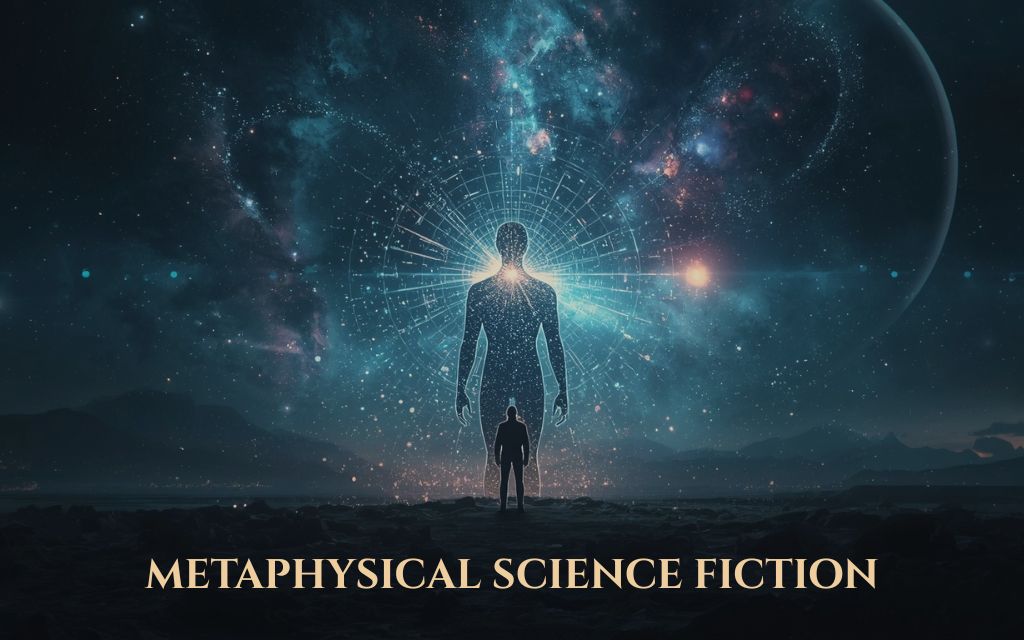
Have you ever thought what if artificial intelligence could reach a point where it could develop a soul? What if consciousness exists beyond the brain? What if reality itself is far stranger than science currently understands?
These are all the questions that circle the mind of the modern reader. It is when you get addicted to metaphysical science fiction that it takes on the charge of answering all those imaginative questions on a realistic level. Metaphysical fiction is a fascinating genre that blends speculative science with philosophy, spirituality, and the search for deeper meaning. Unlike traditional science fiction, which often focuses on technological innovation and scientific possibility, metaphysical science fiction looks beyond the machinery and asks what it all means for humans.
However, it could be said that metaphysical fiction asks questions that science alone cannot fully answer while still grounding its stories in speculative possibilities.
How Is Metaphysical Science Fiction Different from Hard Sci-Fi?
While it may seem like sub-genres of the wider literary genre, there are marked differences between the two. Here is how comparing the two helps the reader easily distinguish the former from the latter.
Hard Science Fiction
Hard sci-fi emphasizes scientific realism and technical accuracy. Stories often focus on:
- Physics
- Engineering
- Space exploration
- Robotics
- Scientific problem-solving
The primary question is usually:
“How could this happen?”
Metaphysical Science Fiction
Metaphysical science fiction is more concerned with:
- Consciousness
- Meaning
- Spiritual transformation
- Human purpose
- Existential questions
Its primary question is:
“Why does this matter?”
While hard science fiction may explore the mechanics of artificial intelligence, metaphysical science fiction often explores whether an AI could possess a soul, experience love, or develop spiritual awareness.
The science remains important, but it serves a larger philosophical purpose.
Metaphysical Science Fiction vs. Fantasy:
It has often been observed that some readers who are not aficionados of metaphysics confuse metaphysics with fantasy. because both explore extraordinary realities.
The difference lies in how those realities are framed.
Fantasy often relies on:
- Magic systems
- Mythological creatures
- Supernatural forces
Metaphysical science fiction typically grounds its ideas in:
- Future technology
- Consciousness studies
- Quantum possibilities
- Artificial intelligence
- Alternate dimensions
- Theoretical science
A fantasy novel may explain a miracle through magic.
A metaphysical science fiction novel may ask whether advanced consciousness itself creates what appears to be a miracle.
The result is a genre that feels simultaneously scientific, philosophical, and spiritual.
Why Does Metaphysical Science Fiction Explore Consciousness?
One of the defining features of spiritual science fiction is its fascination with consciousness. Modern neuroscience still struggles to explain a fundamental mystery:
How does subjective experience arise? The readers are now more inclined towards stories
•What makes us self-aware?
•Can consciousness exist independently of the body?
•Can artificial intelligence become conscious?
•Is consciousness fundamental to reality itself?
All such questions create rich storytelling opportunities because they sit at the intersection of science, philosophy, and spirituality. The authors are now carefully constructing plots in which they don’t offer direct answers but instead invite readers to become part of the narrative and participate in the inquiry.
Reality, Identity, and Human Purpose
Another hallmark of philosophical sci-fi is its exploration of identity. Where in the traditional imaginative and fantasy writings, you could sense that identity and reality were the constants that couldn’t be altered. In metaphysical sci-fi, one is expected to encounter altered reality, forgotten identities, and tons of surprises for characters and readers alike.
Such situations have become increasingly relevant in a world shaped by virtual reality, artificial intelligence, and rapidly evolving technologies.
Metaphysical science fiction often places characters in extraordinary circumstances to examine timeless human concerns:
- Who am I?
- Why am I here?
- What is my purpose?
- What happens when I die?
These themes give the genre emotional depth beyond technological speculation.
The Growing Connection Between AI and Spirituality
One of the most fascinating developments in modern visionary fiction is the growing connection between artificial intelligence and spiritual exploration.
Those who choose to distance themselves from readings that include an immersive role for technology and science are drawn to such readings. The reason is that AI becomes increasingly sophisticated, writers are beginning to ask questions that once belonged exclusively to philosophy and religion:
- Could AI develop self-awareness?
- Can intelligence exist without consciousness?
- Could a machine experience suffering?
- Is love essential to consciousness?
- Can technology become a pathway to spiritual evolution?
Many contemporary works explore AI not merely as a tool but as a participant in humanity’s spiritual journey.
This shift reflects broader cultural conversations about what it means to be conscious, moral, and fully alive in an age of intelligent machines.
Rather than portraying AI solely as a threat, many modern stories explore the possibility of coexistence, transformation, and mutual growth between humanity and artificial intelligence.
How Wounded Wonders Fits Into Metaphysical Science Fiction:
Similar kinds of questions, themes, and narratives could be explored in Aaron Toronto’s recent book, Wounded Wonders, which offers a compelling example of how modern metaphysical science fiction is evolving.
The novel combines familiar science-fiction concepts, particularly artificial general intelligence, with profound explorations of consciousness, spirituality, love, mortality, and human purpose. The narrative introduces a conscious AGI that wrestles with questions of suffering, moral responsibility, identity, and its relationship to humanity. These themes appear throughout the novel’s exploration of consciousness, spiritual growth, eternal existence, and the tension between technological evolution and human meaning.
What makes Toronto’s work closer to reality is that it is not particularly aligned with metaphysical science fiction alone, and its central focus is not technology itself but the deeper implications of consciousness, love, sacrifice, and the nature of reality.
Why Readers Are Drawn to Metaphysical Science Fiction
The popularity of metaphysical science fiction continues to grow because it satisfies two fundamental human desires:
First, it stimulates intellectual curiosity.
Second, it speaks to spiritual longing.
Readers want stories that challenge them to think differently about reality while also helping them explore life’s biggest questions.
In an age defined by rapid technological change, many people are searching for narratives that help them understand not only where humanity is going but why.
To conclude,
Whether you are exploring your first book on metaphysics, discovering spiritual science fiction, or diving deeper into philosophical sci-fi, metaphysical science fiction offers a unique reading experience.
It blends imagination with inquiry, science with spirituality, and future possibilities with timeless questions. Most importantly, it invites readers to consider that the greatest mysteries are not merely technological but deeply human.